
Real-world data for robots that need to work reliably.
Custom egocentric, wrist-camera, teleoperation and failure-recovery datasets—built around your task, embodiment, sensors and training requirements.
Choose the signal your robot actually needs.
Start with the target behavior and model interface—not a generic video specification. We configure collection around your embodiment, sensing stack and learning objective.
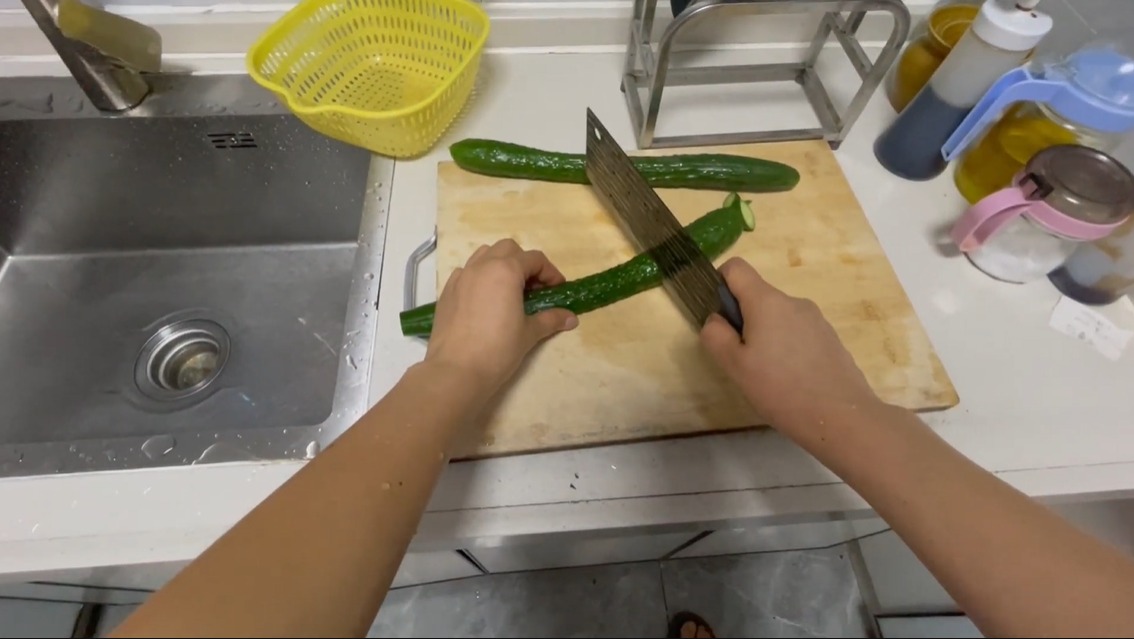
Egocentric human demonstrations
Natural first-person task demonstrations for manipulation, planning, action understanding and world-model training.
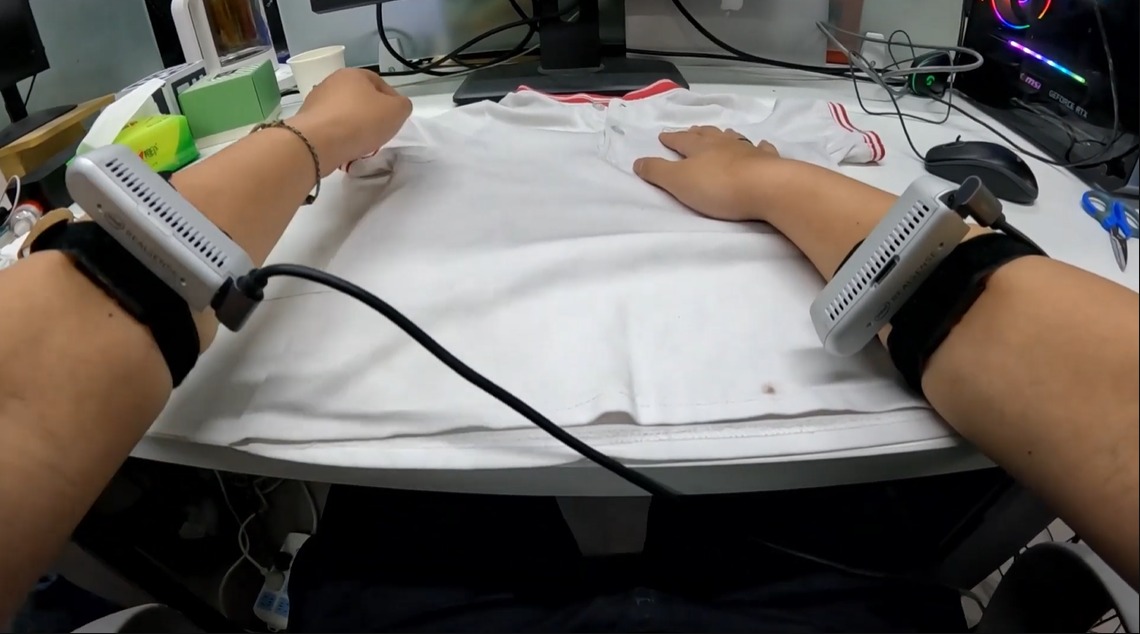
Egocentric + wrist cameras
Synchronized head and wrist views that preserve both scene context and close-up hand-object interactions.
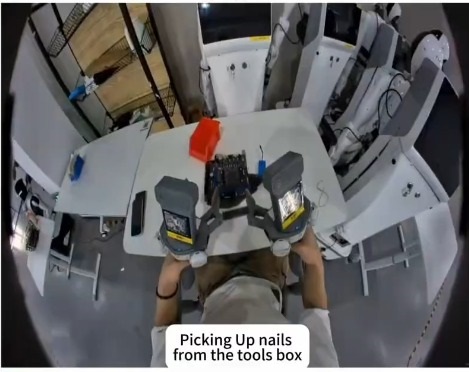
UMI and gripper demonstrations
Embodiment-relevant demonstrations for policy learning, imitation learning and task-specific manipulation.
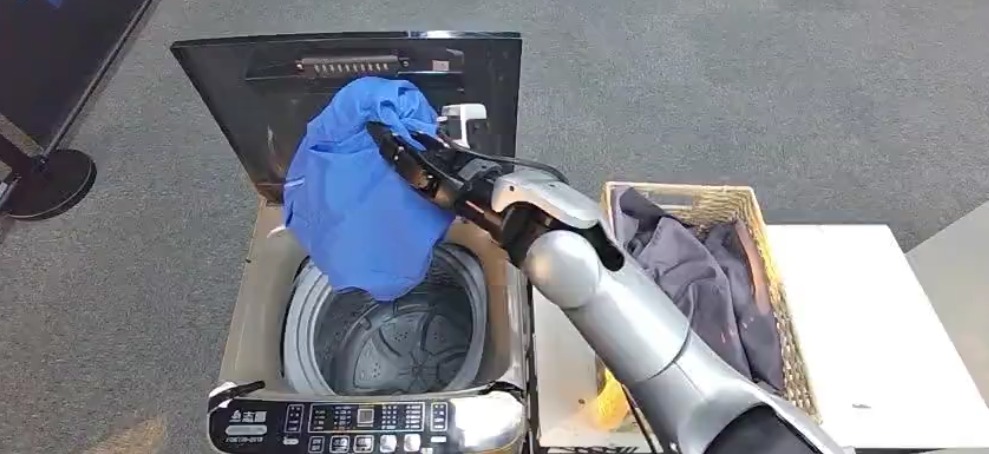
Teleoperation + robot state
Robot-executed episodes paired with synchronized observations, actions, states and operator interventions.
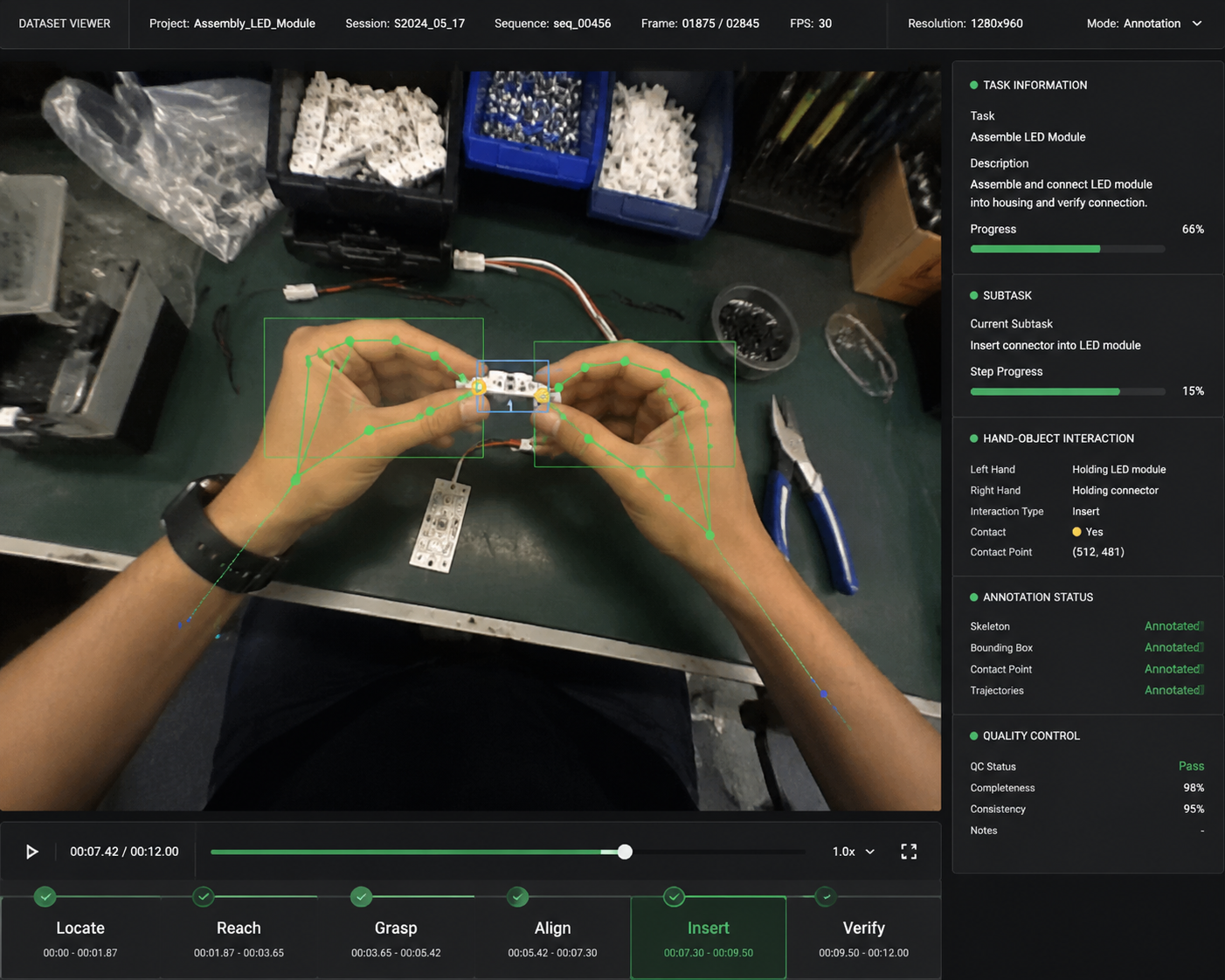
Failure, intervention and recovery
Capture the episodes that expose policy weaknesses: slips, misalignment, corrections and successful recovery.
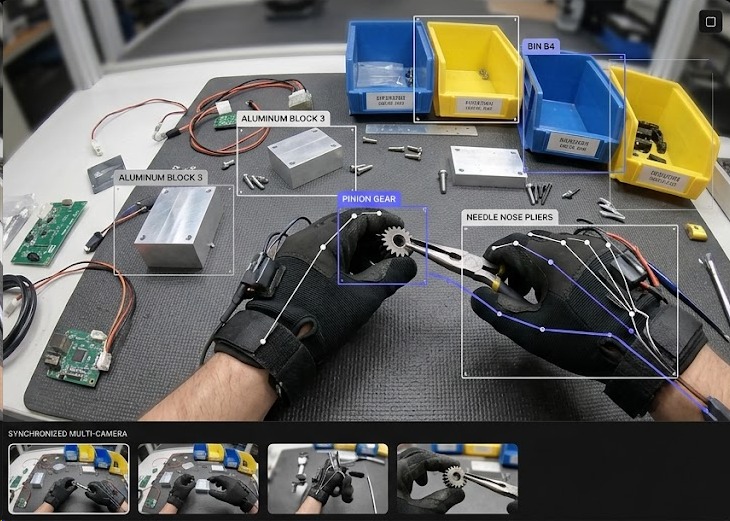
Annotation and multimodal alignment
Task, subtask, event, object and quality labels aligned across video streams and supporting sensor data.
Inspect the capture configuration before discussing volume.
Use these public previews to understand available configurations. Matched raw samples and detailed metadata can be shared through a controlled review workflow.
From task brief to accepted production batches.
Each project starts with measurable requirements. The protocol, pilot and review loop reduce procurement risk before a larger collection begins.
Define the learning objective
Share the target behavior, robot or embodiment, sensors, environment diversity, expected volume and timeline.
OUTPUT / DATA REQUIREMENTS BRIEFDesign collection and QC
Agree camera placement, hardware, task instructions, metadata, consent flow, rejection rules and delivery schema.
OUTPUT / SOW + QUALITY PLANRun and review a pilot
Collect a small representative batch, inspect edge cases, test ingestion compatibility and refine the instructions.
OUTPUT / ACCEPTED PILOT BATCHScale with batch controls
Expand by task, operator, geography or environment while tracking acceptance, rejection and protocol changes.
OUTPUT / MILESTONE BATCHESDeliver and iterate
Provide files, manifests and documentation; use model failures to inform the next collection cycle.
OUTPUT / TRAINING-READY RELEASEAcceptance criteria are written before collection starts.
Quality is not a final spot check. It is designed into the capture protocol, operator instructions, review workflow and delivery manifest.
Visual and sensor integrity
V01Confirm that every required stream is usable and aligned with the agreed technical specification.
Task execution quality
T02Review whether the episode follows the instruction and captures the behavior the model actually needs.
Metadata and annotation
M03Ensure that files, episode records, task labels and quality notes reconcile across the delivered batch.
Documentation and audit trail
D04Provide the records that engineering, legal and procurement teams need to review the release.
Before a pilot starts.
These are the questions we expect robotics, engineering, legal and procurement teams to ask.
Can we review samples before placing an order?
Yes. Public examples show representative configurations. For a relevant opportunity, matched samples can be shared under an agreed review process, with NDA handling where appropriate.
Do you provide existing inventory or custom collection?
Both may be possible. The first step is to compare your requirements with available inventory. When there is no suitable match, a pilot collection can be scoped around the task, sensors and environment you need.
How is quality measured?
Quality criteria are defined in writing before production. Reviews can cover stream integrity, task execution, metadata completeness, annotation accuracy, rights records and batch-level acceptance.
Can you collect failure and recovery episodes?
Yes, when included in the protocol. Collection instructions can target failed attempts, hesitation, intervention, re-grasping, re-alignment and successful recovery rather than only ideal demonstrations.
What delivery formats are supported?
Delivery can be aligned to an agreed schema, including media files, structured metadata, task labels, QC reports and transfer to approved storage. Exact compatibility should be confirmed during the pilot.
Do you claim security certifications?
This page does not claim certifications that have not been formally obtained. Project-specific security, confidentiality, storage and transfer requirements should be reviewed and documented during procurement.